|
Belleville's American Revolution War Stories Courtesy: Belleville Historical Society |
|
|
(Belleville), September 1777 The old Belleville Dutch Reformed Church cemetery is on the west side of the Iglesia Pentecostal La Senda Antigua, 171 Main St., at the corner of Main and Rutgers streets. The cemetery is located along General George Washington's retreat route, and which left behind a contingent of local militia who in a two-day battle delayed British troops as Washington's men retreated. Read More
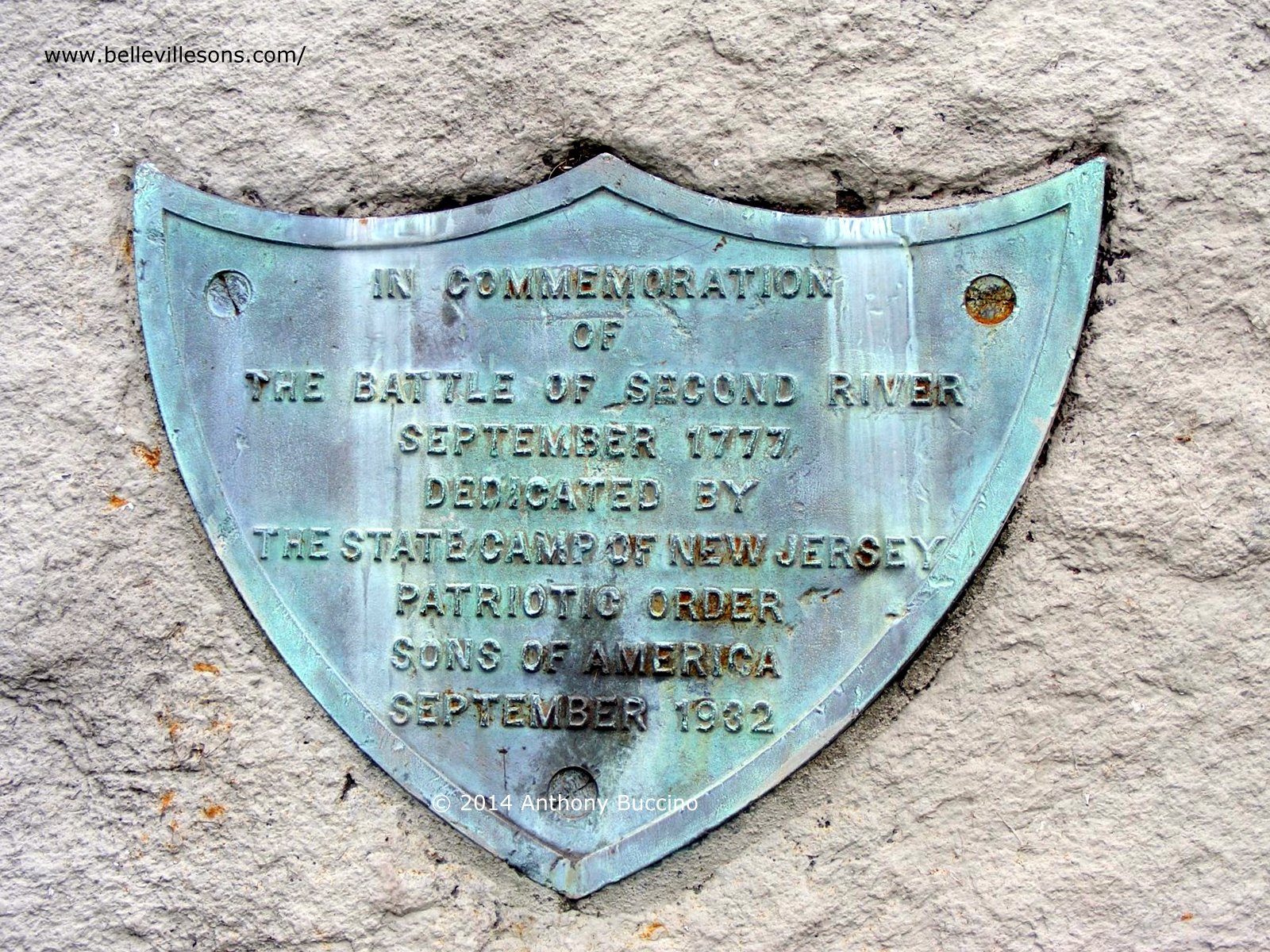
Battle memorial in Belleville Park on Mill Street. VAN CORTLANDT Stephen Van Cortlandt spied a British patrol coming across the Passaic River on the ice. He rounded up the half a dozen militiamen that were in the village at that time. They hid among the thick cedars near the river bank and made such a din that the invaders thought there was a whole army after them and retreated to the other side of the river. It is said that the Van Cortlandts could not draw water from their well without being shot at by the British on the other side of the river. VAN RIPER Cornelius Van Riper was a blacksmith whose shop was the place where slugs of iron were prepared in the absence of ball, having exhausted his supply of iron suited to this kind of shooting, he surrendered to the gunners first his hammer and then his sledge to be used in place of ball. The British discovering the kind of shot used, were heard to call out loudly to their comrades, "Get out of the way for God's sake, before they send us the anvil." SPEER Captain Abraham Speer commanded the Second Essex Regiment that was stationed here at Second River. John Speer, the captain's brother, was a look-out in the Reformed Church belfry when he spied a British officer across the river. He shot him and kept his watch and the brass buttons from his coat. On an occasion Captain Speer was informed just before daybreak five horses had been driven off by a party of refugee Tories. Speer, with two Vreelands and several other men, followed the tracks to the Hackensack. While considering whether they should continue into enemy territory, they spotted a rider farther upstream. One of the Vreelands fired and dropped the man, whereupon several other men, who had been hiding on the opposite bank, broke shelter and fled. The riderless horses neighed loudly and were answered from a thicket where the Second River men found the other horses. CADMUS Second River had its own female heroine in the wife of Peter Cadmus. A party of redcoats approached her homestead. She saw them coming so hid her two children in a large oven built in the side of the fireplace -- admonishing them to keep very quiet. When she refused to give the British any food and wouldn't tell them where the men were, the angry officer plunged his sword in her side. When the Cadmus brothers came home they found her bleeding heavily. The children heard their voices and came out of hiding. Mrs. Cadmus eventually recovered. KIDNEY PLOT: "Captain Kidney's Exploit" Captain John Kidney, Captain Henry Joralemon, Halmark Joralemon and Jacob Garland on a dark and winter night caught the British relaxing at a school house dance in Bergen Heights. They selected the highest ranking officer and a loyalist refugee and bundled them off to a waiting sleigh and brought them back to Second River (Belleville). For several generations the Joralemons proudly exhibited the silver-belted sword of the captured officer. Born c.1748, John Kidney, a captain in the Essex Militia, was the leader of a daring quartet who surprised of group of redcoats partying at Bergen Heights and carried off their highest ranking officer. The other participants in the event, known as "Captain Kidney's Exploit", were the Joralemon brothers, Helmich and (Capt.) Henry, and Jacob Garland. Captain Kidney died at the age of 60 and was survived by his wife Rachel, also buried here. Nikita Barlow: Find A Grave Richard Kidney's home near Smallwood Avenue for years had holes in his front door made by British bullets. RUTGERS PLOT Anthony Rutgers was an artillery captain. He had six children and his eldest son Anthony constructed the first bridge over the Passaic River. Gerard and Robert Rutgers were both colonels. Col. Henry Rutgers, after whom Rutgers University was named, was a colonel and fought in the battle of Long Island. Harmon Rutgers was killed in the battle of Long Island on Aug. 27, 1776. HORNBLOWER PLOT Josiah Hornblower at the time of the Revolution had acquired considerable property, was the father of a large family and had become a justice of the peace. He was an ardent patriot, and though too old to carry arms himself, he served the Revolutionary cause with advice, financial aid an as a member of the Provincial Assembly. He brought the first steam engine over to America in 1753 to pump the water out of Schuyler mine. The British regarded Hornblower as a very dangerous man, and several times he barely escaped arrest. It was small wonder that he watched prudently from his porch as a rather large party of men were being ferried across the Passaic River by Robert Kip, his son-in-law. At first the score of strangers seemed inoffensive enough of Kip. They were dressed as farm laborers, and had a plausible reason for crossing. But in the middle of the stream they pulled pistols from under their greatcoats, primed them and got ready for action. Kip kept his peace until the ferry was near enough to the shore so that Hornblower, still seated on the porch, would hear his call. Then he dropped his oars overboard, rose to his feet, and shouted, "Father, the British!" History holds no record of what the British did to Kip. Hornblower had flown and his daughter, Kip's wife, had been able to hide the family silver. The enemy searched and set fire to the house, but rain and neighbors extinguished the blaze before much damage was done. Sources: Belleville Historical Society, History of Kearny, Find A Grave |
Belleville Sons Honor RollA Place of Honor and Remembrance In the Home of the Brave Belleville, New Jersey Belleville and Nutley were the village of Second River, that is, the village included all the land between the Second and Third rivers, or roughly from present day Mill Street in Belleville to Kingsland Road at the Nutley-Clifton border. Web site sponsored byBELLEVILLE SONS HONOR ROLL - Remembering the men who paid for our freedom Old BellevilleAnthony Buccino
|
Email CommentsSnail Mail: PO Box 110252, Nutley NJ 07110 Entire contents BellevilleSons.com Copyright © 2003-2017 by Anthony Buccino, All Rights ReservedPhotos and content may not be used without permission |
|